
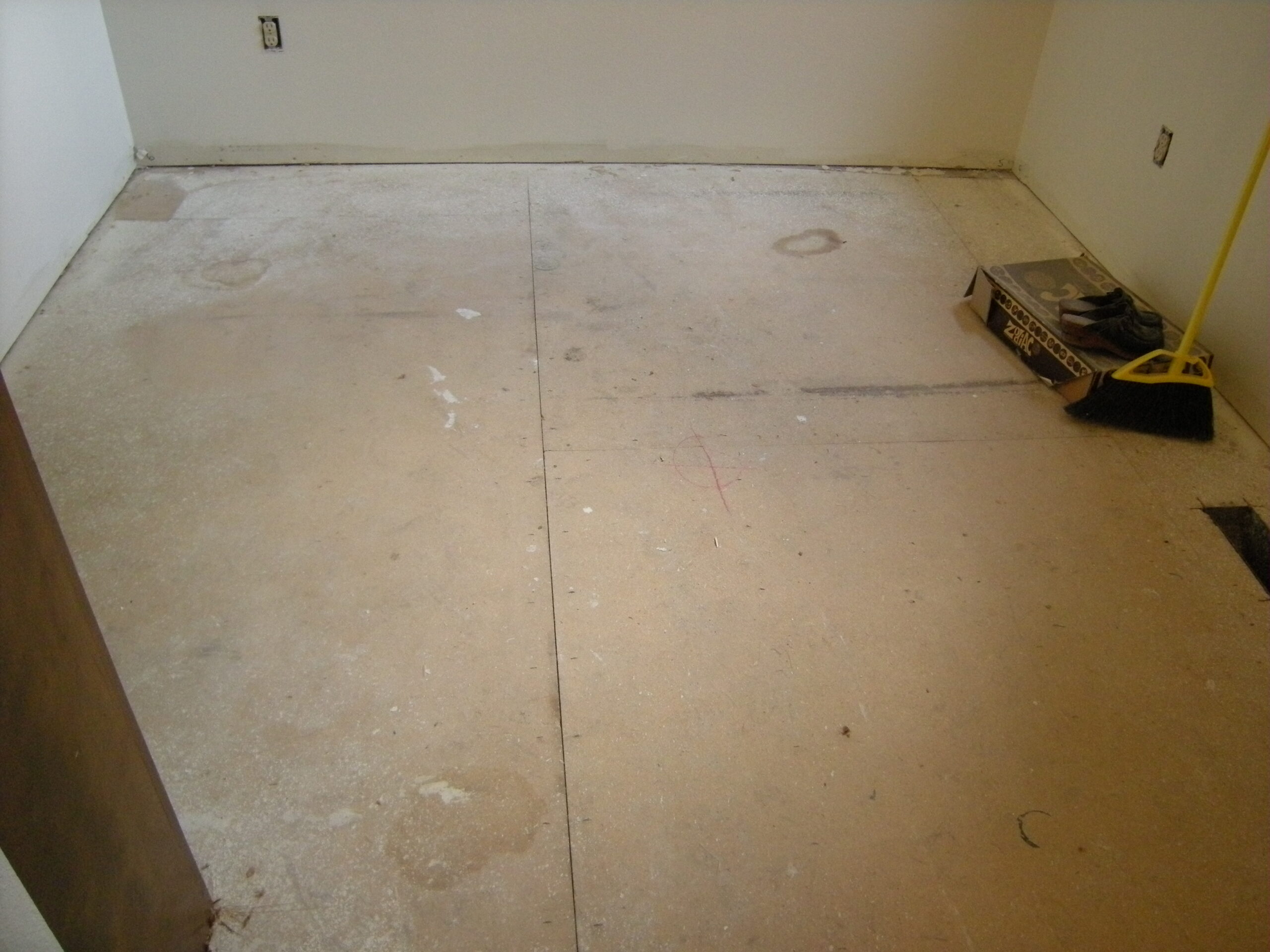

Underlayment
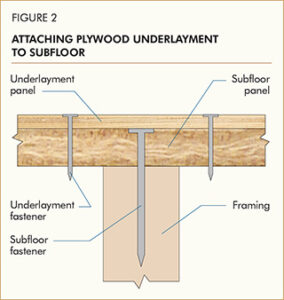
The layers of the floor are often confused. The terms are used by some interchangeably
- Underlayment (Goes under the floor but above the sub-floor
- Sub-Floor (goes on top of the joists)
Underlayment
Underlayment is a general term for what goes under the part of the floor that you see. It can be made of all sorts of things. The most common underlayment is particle board. Why this stuff is made of saw dust in many cases is beyond me. Underlayment is used beneath sheet goods (Vinyl flooring) it is like a sponge. Bathrooms are a wet rooms, once seepage from the shower or toilet gets around the edge of the vinyl nothing good happens.
Floor detail
How thick should you underlayment be?
I prefer to not have altitude changes between different types of flooring so I plan ahead and use what mathematically works out best. Do a mock up if you need to see what you are doing. We also insist on taking the underlayment out and replacing it when installing new flooring. Sure you could skip it but don’t. It is not that much extra work to remove and reinstall it.
Plywood is occasionally used and it works as long as it is good quality stuff like Baltic birch.
Installation is not standardized either. It never needs glue! screws are frowned upon too because they cause the substrate to mushroom which will telegraph up into the floor surface. Typically nails are enough. Some installers use staples which is OK too. The recommendation is to put your narrow crown staples ever 4″- 6″ and every 1″ on edges. That is a hell of a lot of staples.
proper preparation includes verification of smooth surface which could include patching (I prefer cementatious patch but plaster type patch works OK too. Water is the enemy of (plaster based patch) and or sanding.
Sub-floor
We deal with all sorts of sub-floors from diagonal 1 x 4 sheeting to 5 quarter OSB the important part is that the proper material is used to span the joists and that the material is supported well enough to not deflect if you choose to put a heavy floor like tile to be placed upon it.
At one point 2″ x 6″ x 1 3/4″ T&G (Tongue and groove) wood was used and the entire sub-floor then completely with 3/4″ particle board underlayment then the walls were built in top. This technique was short lived and I believe very wasteful.
Repairs
I am replacing some for a friend this weekend. Their situation is that they have a weak area where a return air register once was. They also have an extra floor register for the return air which I am going to eliminate because the one up high on the wall is a better setup. Plywood will be my material of choice because we need to span a fair distance. I ended up adding additional structure then used standard underlayment.
Tile
Tile gets cementatious underlayment in my world. The most important thing to remember with tile is that the home has to be strong enough to handle the extra weight. My rule of thumb is “If you have to ask, The answer is yes!” that means shore up the floor before you install tile.
Hardwood
Hardwood typically gets installed right on the Sub-Floor.
Floating flooring
These materials go directly on the underlayment. Some use a pad that rides on the underlayment first.
Carpet
Carpet also gets attached right to the Sub-floor usually using tack strips with those painful little spikes.
Your comments are welcome. To ask questions or get more information about proactive home care, click here to email me directly, or call 208-639-1808
If you or someone you know could potentially use our services, or just wants to speak to a trustworthy contractor please contact me, you’ll be glad you did.






0 Comments