
How Heat Moves Around
I have been confused for years about just what the term R-value means. You would think that if you have 16″ of insulation it should correlate to an R-Value.
That is all well and good, as long as you are talking about the exact same insulation. What an R-Value is, as it turns out, has lots of variables.
R-Value is the commonly used term to describe the thermal resistance ability of insulation.
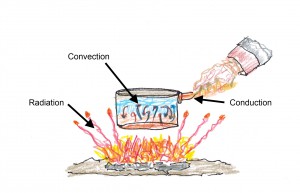
As you recall heat travels through 3 means:
-
Radiation
- = Heat travels through the air Example: heat from the sun warms you through radiated heat. (It is important to understand that Radiated heat does not pass through solid materials. Radiated heat passes through solid materials through conductivity.)
-
Conduction
- = When two things are touching, heat travels through from one to the other. Example: touching something hot means you get burned.
-
Convection
- = Heat rises. Example: when a cold pot of water is placed on a hot stove, the heated water at the bottom of the pot rises and the cold goes to the bottom of the pot. Air does the same thing.

Spraying Foam
Insulation is often misunderstood. Insulation only slows the travel of heat from high temperature to low temperature. How well it does that determines its R-Value. The R-Value was once described as a U-Value prior to 1945, and a lower U-Value was better. However, as a marketing tool the inverse of U was used after WWII because it is human nature to think larger numbers are better.
Many factors influence how well insulation works. There are all kinds of materials with insulation properties. These days we fill voids in building walls with fiberglass insulation, and we use spray foams of all types too.
Insulation has evolved over the years as we have understood it better. I have found walls packed full with newspapers, and just heard of a story from a client who has a cabin in Silver City As they drilled a hole into the wall the bit got stuck, after putting it into reverse the bit let go. When they looked in the hole, they found all sorts of clothing. We assume they packed old clothing into the wall for insulation. It makes sense, as we wear clothing to insulate us from the cold. Rock wool and vermiculite are two other commonly found materials that were and used prior to fiberglass taking over the market.
Installing Net & Blow
As it turns out, air infiltration has a lot to do with how well a wall or roof assembly works. This is why we use a plastic engineered house wrap on the outside of homes to create a wind barrier.The cautionary tale is that you can overdo it in the sealed up home that is so tight that it does not breath. This is where an ERV or HRV to bring in fresh air and exhaust stale air might come in handy, like we used in a below grade, dirt insulated home we worked on several years ago.
As building science improves and our homes become more energy efficient, we can look for better materials to insulate with.
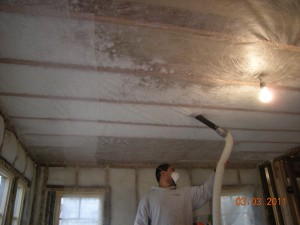
In our region, R-38 is specified as a proper insulation for on top of a ceiling. This is achieved commonly with blown in insulation. Depending upon the R-value of the material used, the appropriate blanket of material is installed. The better the R-Value per inch of the material, the less of it you need. This is where foams perform better. They also dramatically decrease the amount of air flow cutting down the conductive heat loss. As an example, the space shuttle insulation tiles are R-50 / inch.
Open Face Batt Insulated exterior Walls
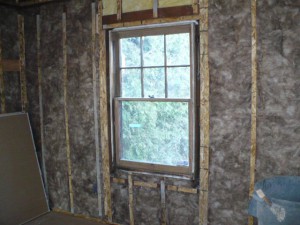
Most remodelers just call the insulator, or do it themselves, but at Levco, we take a more aggressive stance. We have a great relationship with our subcontractor and have long discussions at times to make sure we use the appropriate material for the specific situation. We have used all sorts of techniques like batts, net & blow, flash and batt, and blown in. We have used all sorts of materials too, including cellulose, high density foam, low density foam, high and low expanding foam, backer rods, and baffles to make sure condensation is kept to a minimum despite living in an arid climate.
At Levco, each project gets an energy inspection. We have a building inspector respond to verify that the correct materials and assemblies are employed not only to vensure that the plans are being followed but that best practices are being adhered to for our climatic conditions.
Your comments are welcome. To ask questions or get more information about remodeling, click here to email me directly, or visit our contact page.




0 Comments